


The Messy Middle of Transformation

When the Future Becomes Visible Before It Becomes Comfortable
Over the last few weeks, I’ve been thinking a lot about transformation.
Not the frameworks or operating models. They are just the mechanics. What I’ve been pondering is why transformation remains so difficult, even when the need for it is obvious.
When We Can See the Future, But Aren’t Ready for It
Most leadership teams are not blind to change. They can see customer behaviour evolving, technology reshaping industries and new business models emerging. They understand that competitive advantage rarely lasts forever.
The challenge is seldom a lack of awareness. The challenge is that the future becomes visible long before it becomes comfortable.
I was recently with a leadership team reimagining what their business might look like three to five years from now. The conversation was energetic. There were ideas, possibilities and opportunities.
Yet underneath it all sat an unspoken tension.
The current business is real. It has customers, revenues, capabilities and people whose careers have been built around making it successful.
The future business, by contrast, exists mostly as a belief. A hypothesis. An aspiration. Something that can be described, but not yet touched.
And perhaps that is what makes transformation so difficult.
The Hardest Part Is Letting Go of What Works
We often talk about the need to build the future. What we talk about less is the need to gradually loosen our attachment to the present.
Not because it is wrong. Quite the opposite. The current model is usually the reason the company exists at all.
But there comes a stage in the evolution of some businesses when yesterday’s strengths start becoming tomorrow’s constraints.
When we look back at companies like Netflix or Microsoft, their reinventions appear almost inevitable. We know how the story ends, so the decisions seem obvious.
But I doubt they felt obvious at the time. You cannot connect the dots looking forward!
I suspect there were many conversations filled with uncertainty. People questioning whether they were moving too early, investing too heavily, or abandoning something that still worked.
Because that is the reality of transformation.
The Choice Is Rarely Between a Bad Business and a Good One
You are rarely choosing between a bad business and a good one.
More often, you are choosing between a successful business you understand and a future opportunity that is still taking shape.
That is a much harder decision.
The existing business has evidence behind it. Its revenues can be measured, its customers are known, and its capabilities have been tested. The future, meanwhile, asks leaders to commit resources and make choices before all the answers are available.
There is no guarantee that the new model will work. But there is also no guarantee that the old one will continue to work as it always has.
This is the tension at the heart of transformation.
The Courage to Endure the Messy Middle
What strikes me is that organisations that navigate these moments well possess a particular kind of courage.
The courage to commit before something is fully proven. The courage to believe in a different future while the evidence is still emerging. The courage to invest in capabilities and business models that may take years to reveal their value.
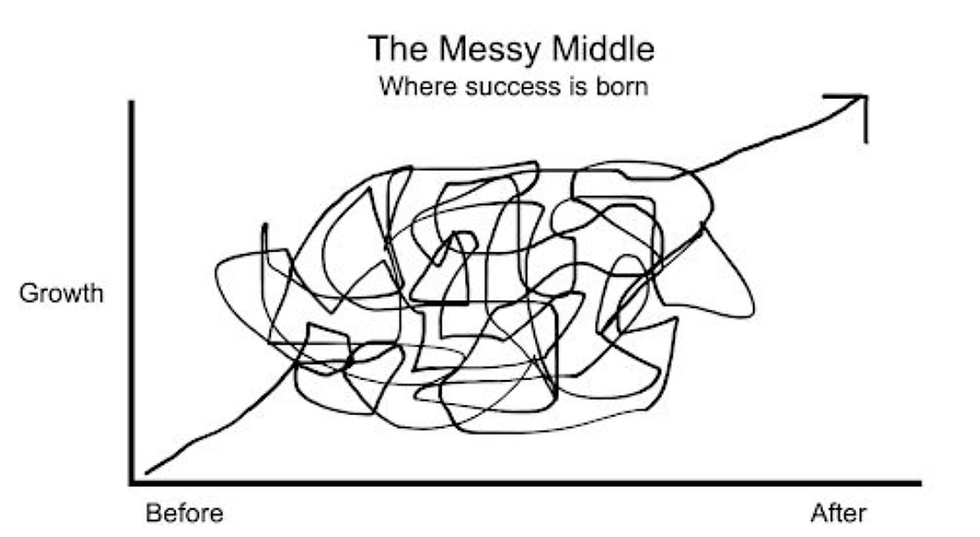
And perhaps most importantly, the courage to endure the messy middle.
That awkward period where the old model is no longer enough, but the new one is not yet fully formed.
It is a period in which the business may still depend on the very model it is trying to move beyond. New capabilities take time to mature. Customers may not move as quickly as expected. Revenues from the emerging business may not compensate immediately for the pressures on the existing one.
For leaders, this can be an uncomfortable place to be. They must continue to run the business that pays the bills while building the business that will sustain its future.
And they must do so without the reassurance of knowing exactly how the story will end.
This Is Where Leadership Matters Most
Most transformation stories are told through their outcomes. We celebrate the reinvention. We admire the growth that followed.
What we rarely talk about is the uncertainty that sat in the middle of the journey.
Yet that is where leadership matters most.
Not simply in setting a vision or announcing a new direction, but in helping people navigate the distance between what they know today and what they must learn to become tomorrow.
Because long before others believe in the future, someone has to be willing to build it.
To discuss your business transformation, connect with anjali@c-xcel.com


Comments